
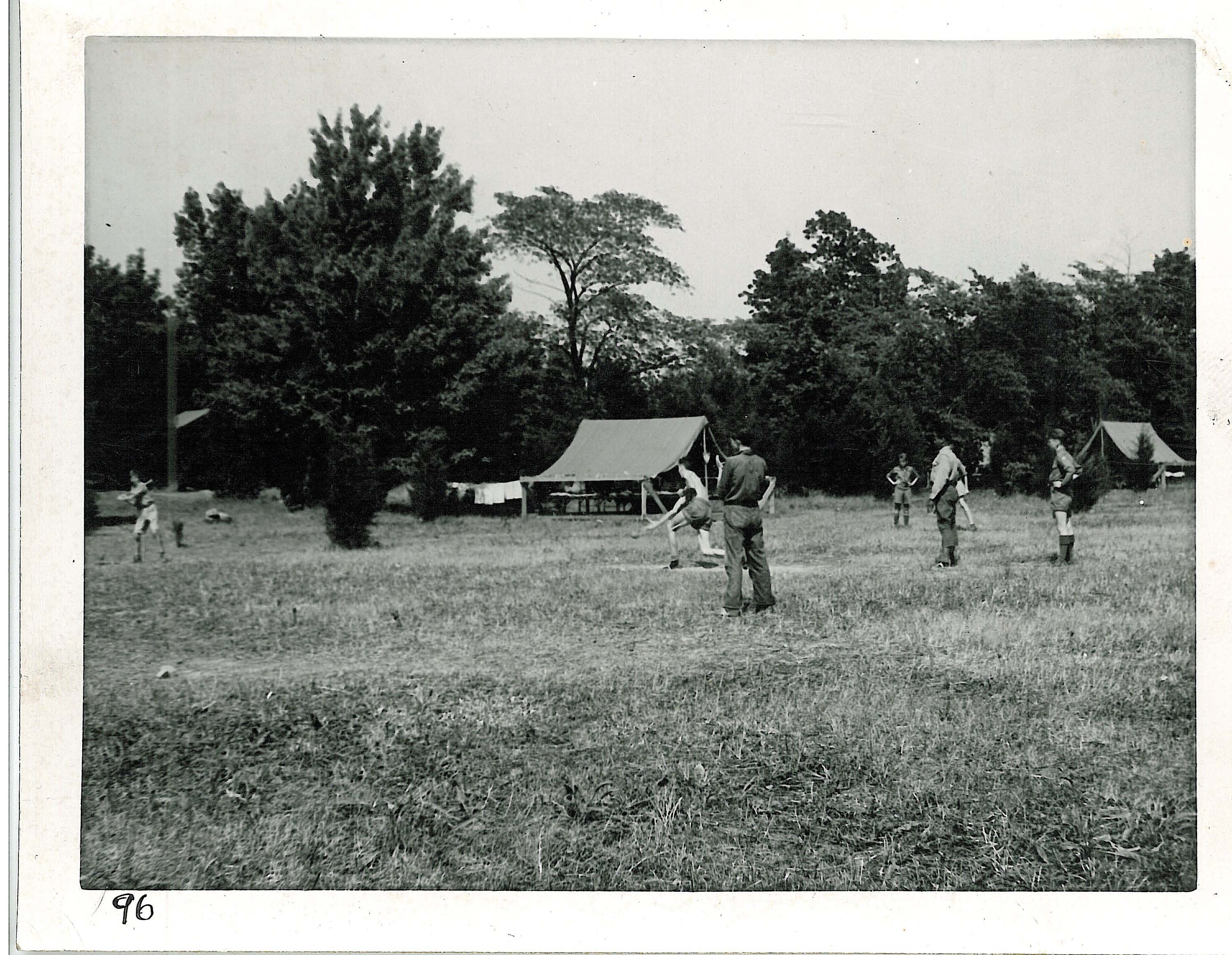
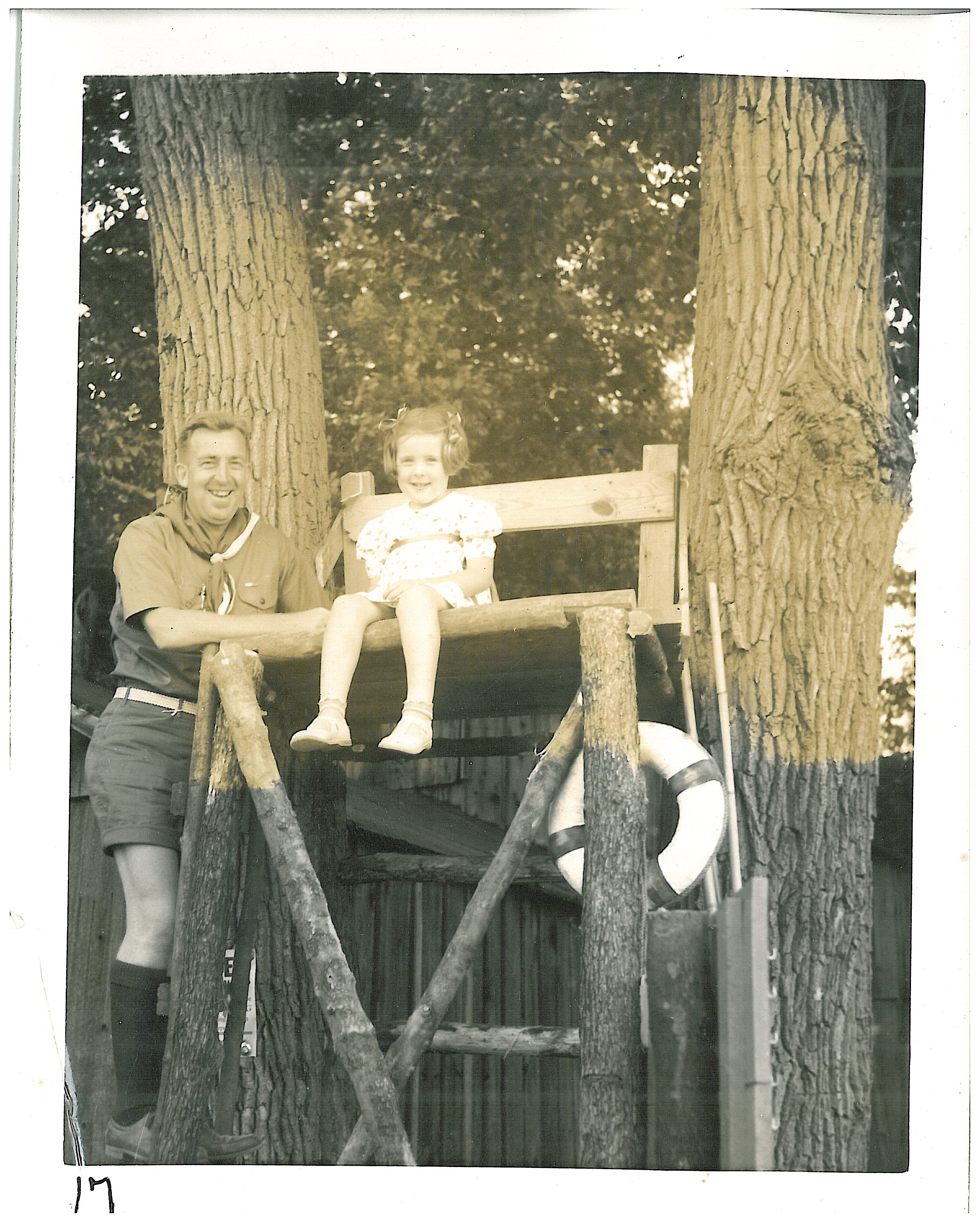
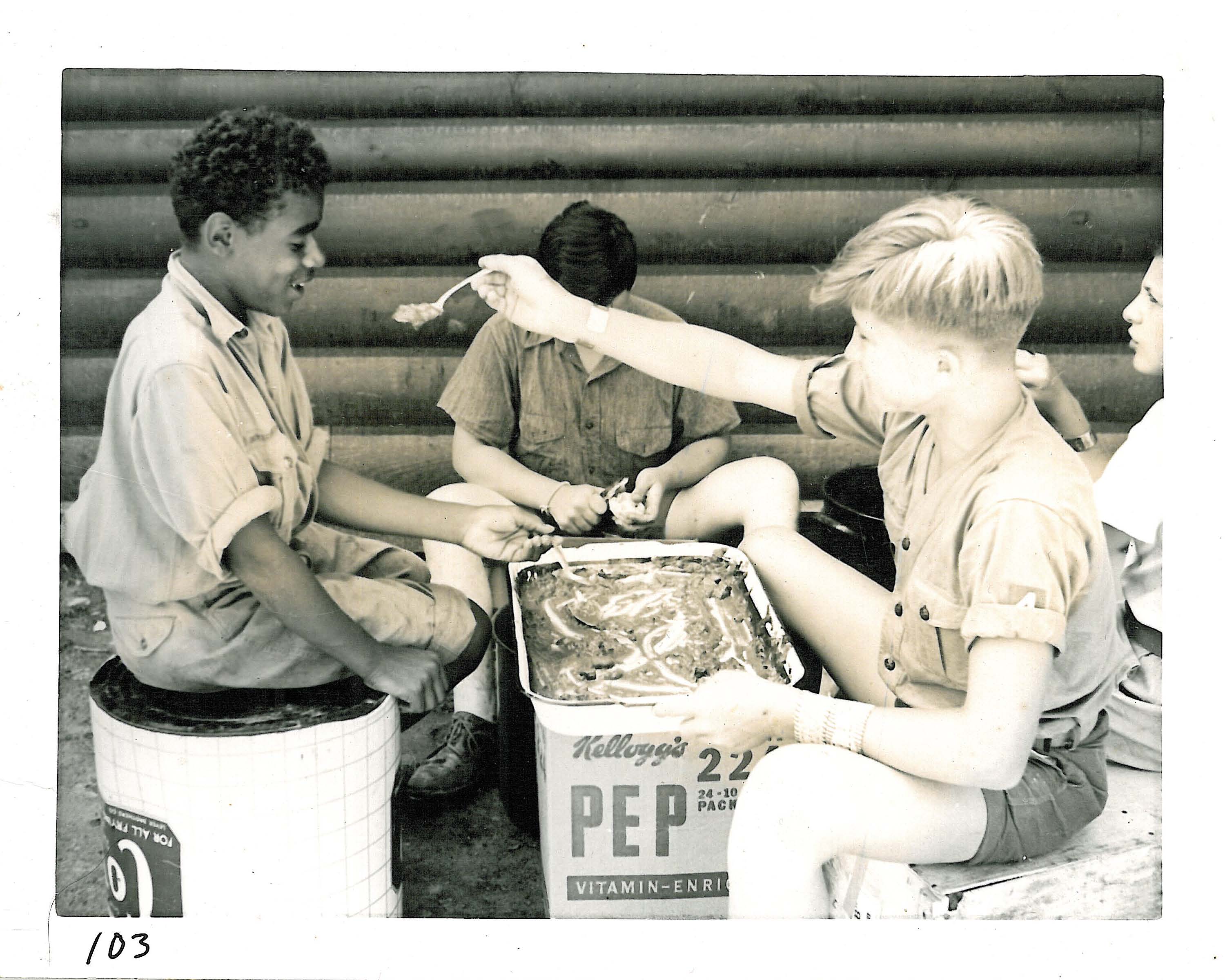
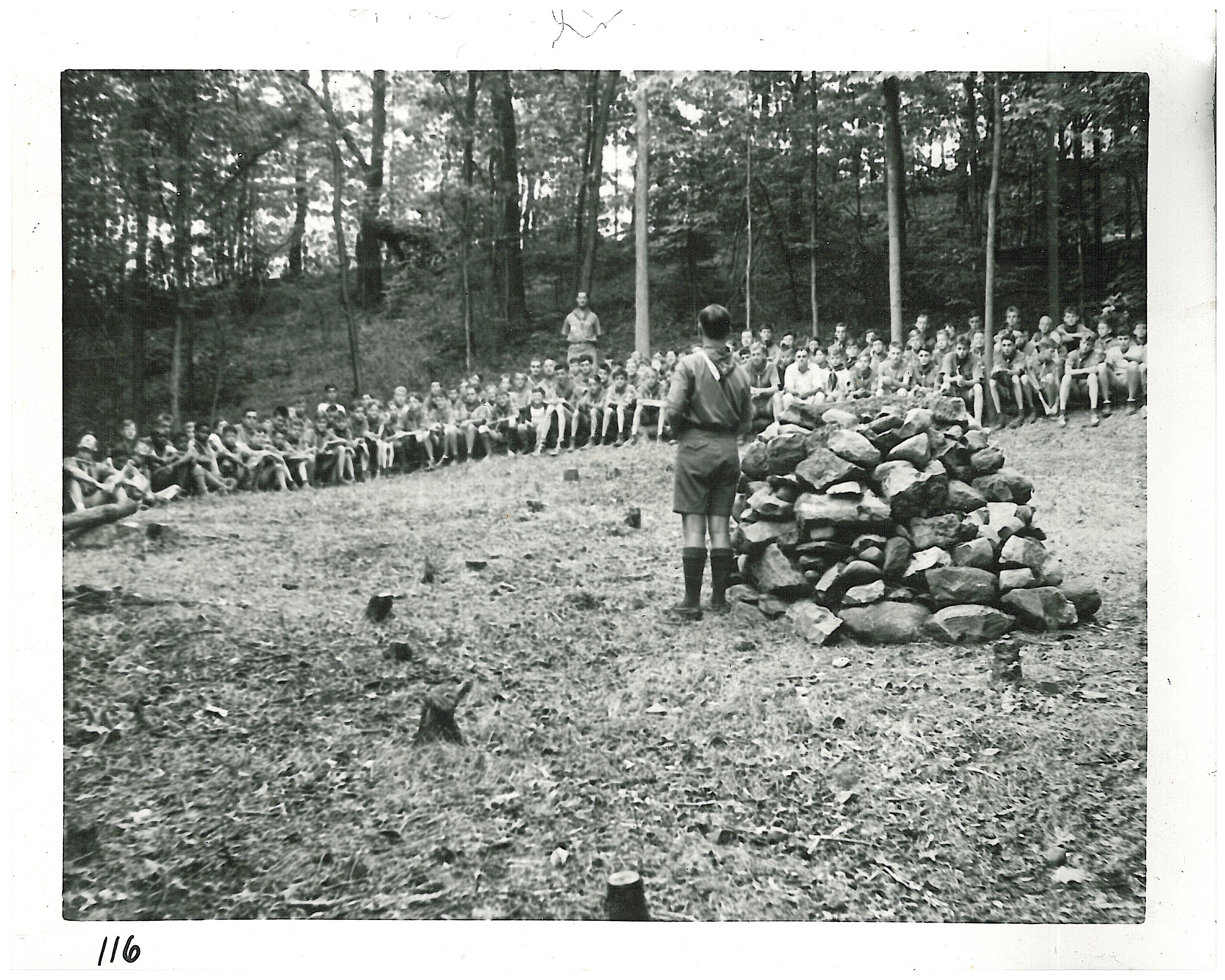
When camp first opened there was only the dining hall (2012 – south wing, center section and ½ of north wing), the outdoor shower building (2012 – concrete slab between Memorial Lodge and Mohawk campsite on south side of access road), the maintenance building (2012-only the garage bay and one section to the east, western section added at a latter time), the present Chaplain’s Quarters (1987) that served as a trading post and handicraft building (2012 – Memorial Lodge), a wooden boat house (2012 – near current town pumping station) , an “F” type dock, a high lookout chair, the flag pole, the fire bell, the stone base upon which a hermits cabin had sat (2012 – stone wall is still located south of Tuscarora campsite on path to Sunday night campfire to the left), and a totem pole located in the loop of the road near our present kitchen. There were 3 sites for campers located in the same place they are today namely Mohawk, Onondaga, and Cliff Dwellers (Cayuga 2012). Staff were quartered in Oneida Site (2012- Between Eagle Lodge and Tuscarora campsite on south side of access road).

#9 The Dedication of Camp

The Dedication of Camp
Sparkling blue water, and sunny skies m’ngled with hundreds of flags and uniforms yesterday in colorful pageantry as Camp Babcock-Hovey, new camp of Finger Lakes Council, Boy Scouts, was dedicated.
Upwards of 1000 Boy Scouts, drawn from Seneca, Yates and Ontario county, participated in the event, witnessed by some 5,000 Scouters, parents of the boys and friends of Scouting, at the camp site, located on the east shore of Seneca Lake near Gilbert Station. The dedication marked a high point in the history of the Council and one of significance to American youth.
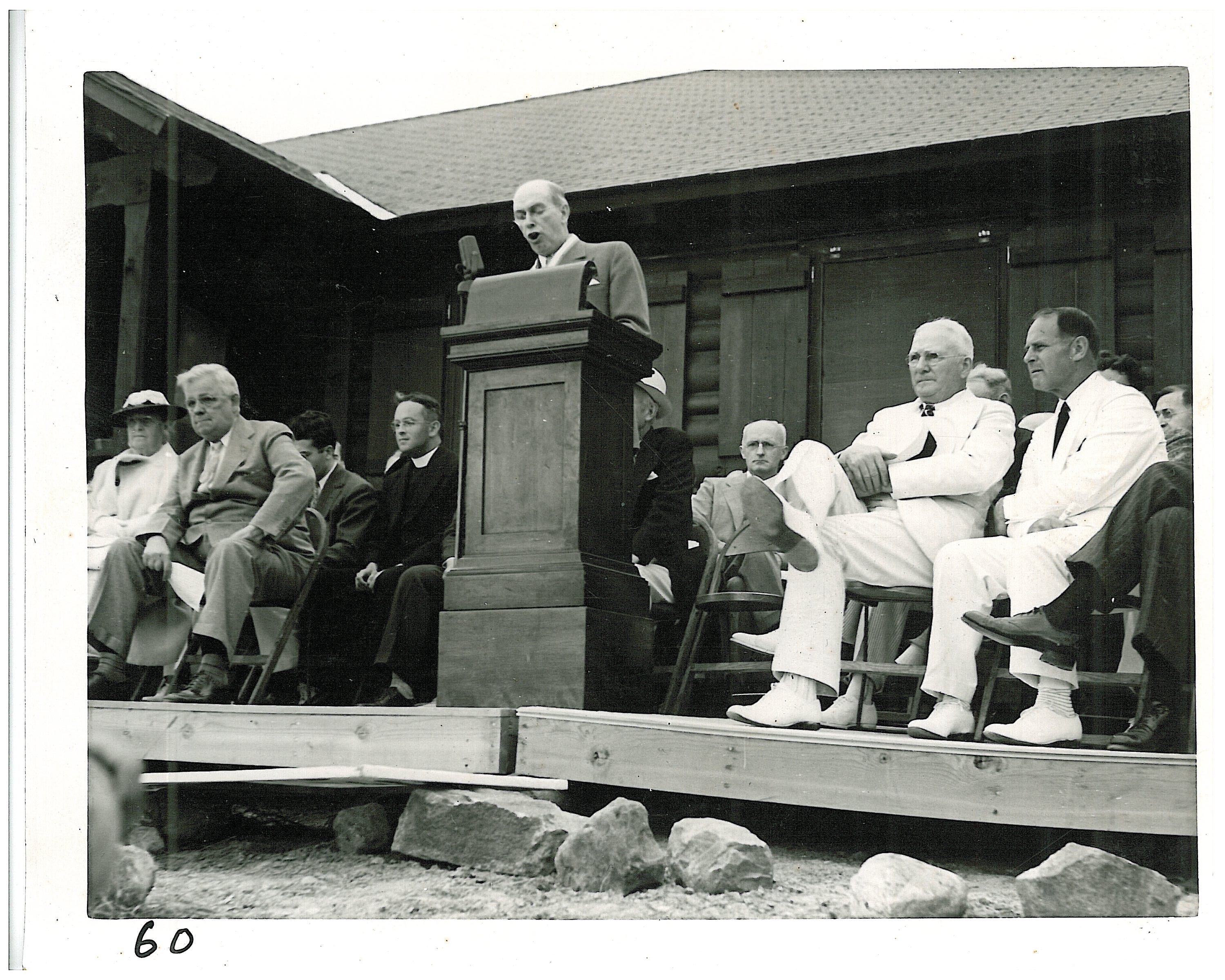
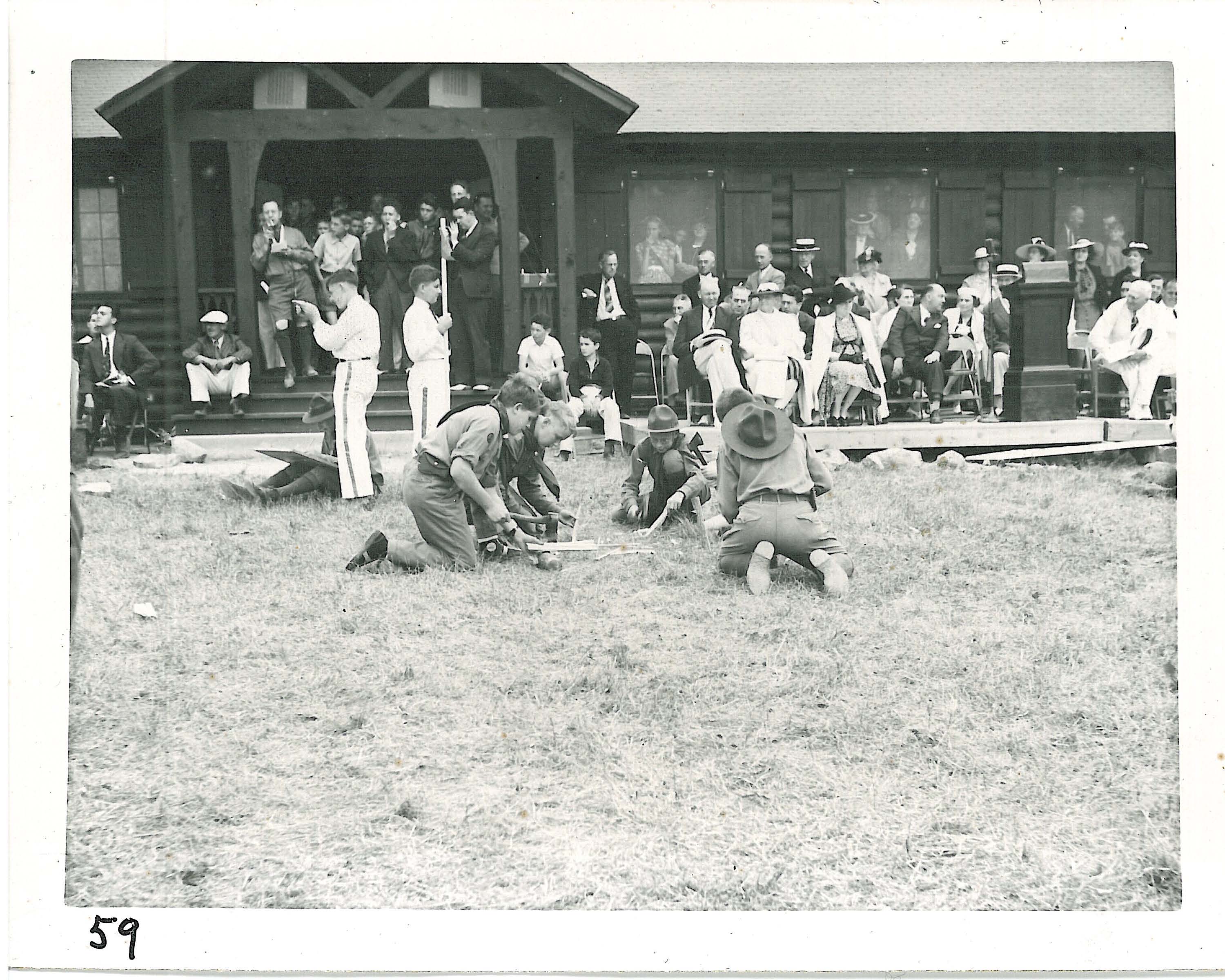
On a platform set up near the main lodge, but recently completed, overlooking the lake and the beautiful woods and ravines of the 144 acre camp site, a large group of distinguished guests paid tribute to the Boy Scouts and to the men whose gifts and effort made possible the establishment of the camp. Berton E. Babcock, Phelps, and Harry E. Hovey, Geneva, gave equal parts of $13,500 to purchase the site and erect the buildings
“Boys who have had a part to organized recreation are seldom met in court,” said Dr. Frank L. Christian, superintendent of Elmira Reformatory, the principal speaker of the afternoon. Dr. Christian discussed the value of Scouting to the community and to the boy. He cited the social, economic and educational advantages of Scout training and said that the national scope of the Boy Scout movement is of vital importance to the future welfare of the country.
“Almost without exception,” Dr. Christian said, “the boys who come to Elmira blame their difficulties on bad companions. They don’t meet them in Boy Scout troops. The Scout patrol unit is a gang, but a gang properly directed and practically trained. Records show that of the many thousands of boys arraigned to court there is an entire absence of Scouts and future good citizenship is assured in the lasting Effect of Scout training and camp life.”
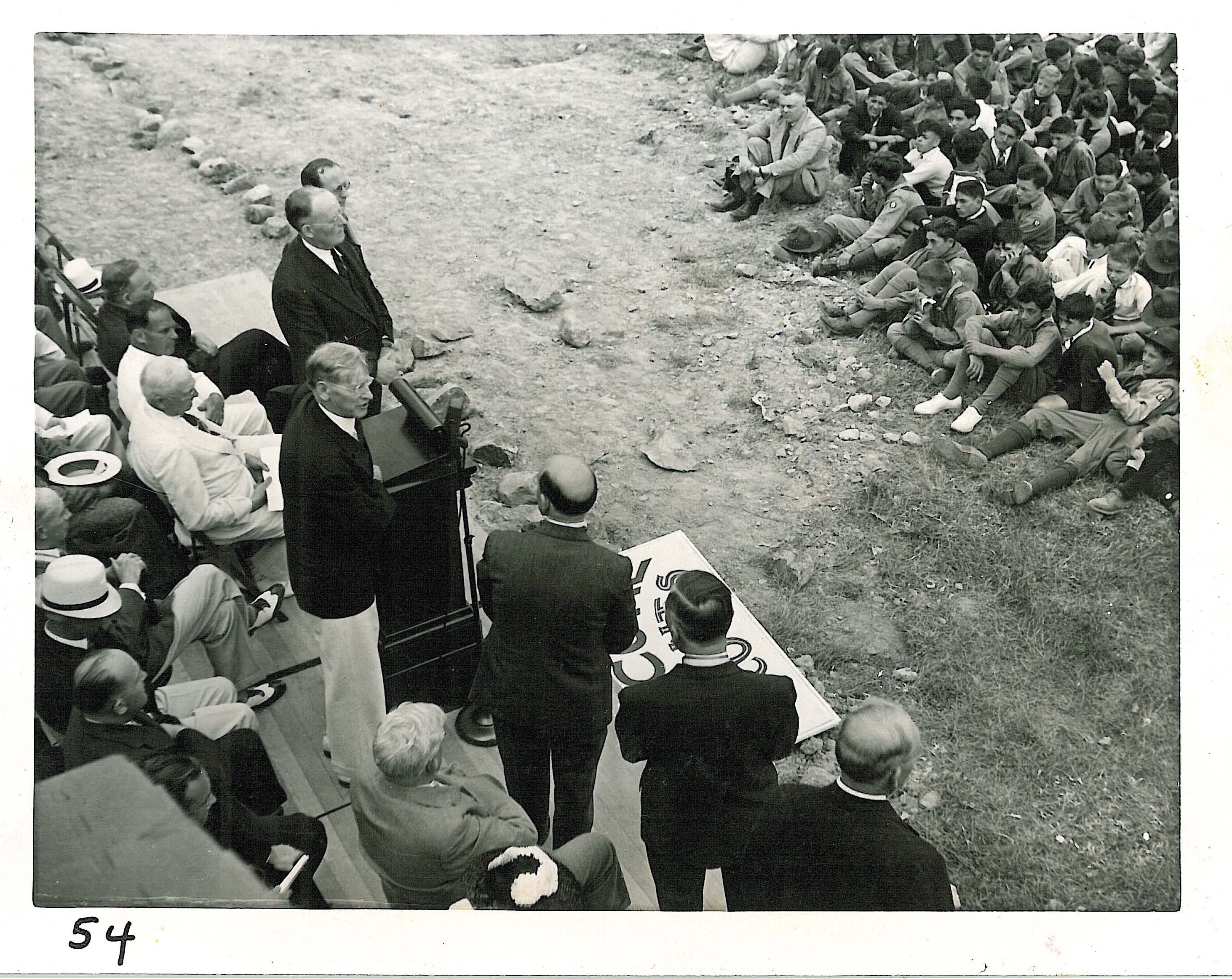
A pertinent remark also made by Dr. Christian was that there is no such thing as a delinquent boy. It is the parents who are delinquent, he declared.
Program at Camp
The program at the camp opened at 2 o’clock. More than 100 visitors and distinguished guests were entertained at luncheon earlier in the afternoon by Supreme Court Justice Nathan D. Lapham at the Geneva Country Club. Justice Lapham was chairman of the dedication committee and had worked for weeks on the program,
A Scout bugler, sounding” the “assembly” signaled opening of ceremonies at the camp and the enactment of a brilliant scene. Members of the commissioner’s staff directed a review of the 44 Scout troops at camp for the day. Members of the staff of Commissioner Arthur J. Cowan, Geneva, all of whom played an important part in the day’s program, were: Richard Rathbun, Phelps; John J, Pryor, Geneva; A. A. Gould, Geneva; Francis Orcutt, Penn Yan; W. O. Burgess, Seneca Falls; David R. Rolfe, Clifton Springs, and M. T. Munn, Geneva.

A flagstaff, gift of the Ovid Business Men’s Association, was presented by Anthony Wylie. A flag was presented by Winnek Post, American Legion, by Lyman H. Hammond, Americanization officer, and the staff and flag were accepted by Dr. Murray Bartlett, president emeritus of Hobart and William Smith colleges, for many years a favorite with Finger Lakes youth. The flag-raising ceremony was conducted by the camp color guard and the Romulus Central School band, directed by Maurice Rose, played the “Star Spangled Banner.”

Dr. Bartlett said in his remarks: “The flag stands first of all for the precious gift of liberty. The keynote of liberty is freedom of thought and speech, a liberty equaling tolerance, the note most needed today.
“There can be no freedom of thought and speech without tolerance which, in simple terms, means trying to understand the other fellow and work with him.” Dr. Bartlett also referred to the fact that Scouting unites all creeds.
The Rev. Raymond Nolan, Geneva, Council chaplain of Catholic Scouting, gave the invocation and all Scouts participated in the pledge of allegiance and the Scout Oath George Lawson, Dundee, Council president, gave the address of welcome. Eagle Scouts of the Council for years back were presented in a group numbering more than 100. By Arthur J. Cowan. The Eagle award was given to Wilbus Comstock, Troop 44, Penn Tan, by Harry Weart, chairman of the camp committee. Olier B. Barley Is scoutmaster of the Penn Tan troop.
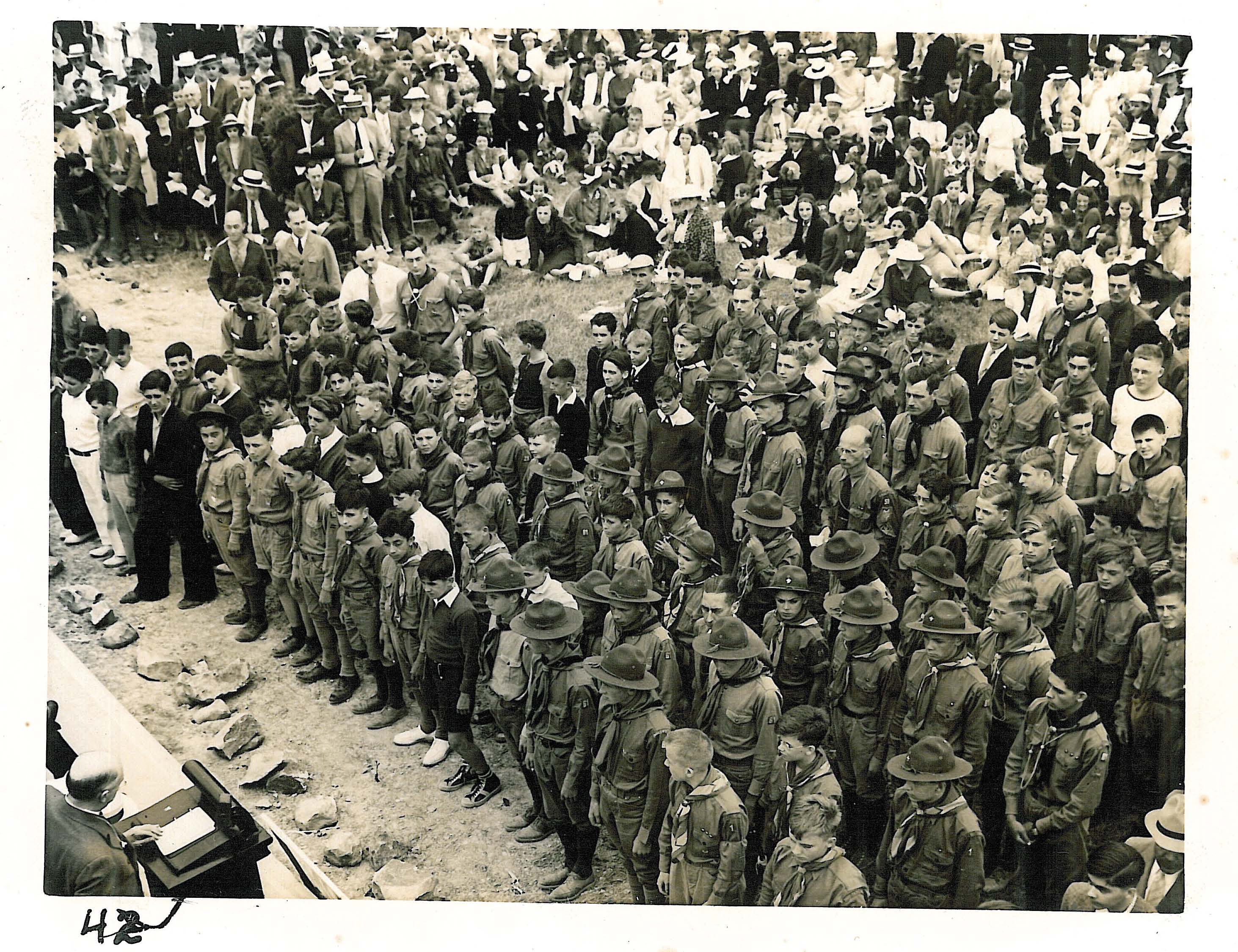
One of the moat impressive parts of the ceremony was the presentation of the Silver Beaver Association, a group of men who for distinguished service to boyhood through the years of the Finger takes Council organization, have received the highest honor within the gift of the Boy Scouts of America. They are: Ira N. Croucher, Canandaigua; Edward C. Russell, Seneca Falls; Ainsworth M. Bennett,
Manchester; Justice Nathan D. Lapham, Geneva; Charles S. Wilson, Hall; Lee H. Leland. Clifton Springs, and W. G. Warr; Geneva.
Two new names were added to the list of Silver Beavers in a presentation made by O. H. Benson, New York city, National Director of Rural Scouting. Receiving the honors were Dr. Alfred W. Armstrong, Canandaigua, and Arthur J. Cowan, Geneva.
Dedication Address
In a dedication address, Charles S. Wilson, Hall, said in part: “Because of this camp we dedicate every Boy Scout in this Council to the renewed task of building a nobler character, of becoming a better citizen, for these attributes are the essence of Scouting. We dedicate even more-we pledge that every Scouter, inspired by these gifts, will give to the cause of Scouting in the Finger Lakes Council, from his experience, more of his time and effort than he has ever contributed before.”
Of the two men whose gifts made the camp possible, Mr. Wilson said: “Mr. Babcock and Mr. Hovey have achieved in industry and we recognize that their accomplishments have been great. By their contribution of this camp to the Boy Scouts, they have written their biography in the life of every Scout who camps here, and thereby given to that boy the incentive and encouragement to work and succeed that has been theirs.”
Requesting the two men to rise, Mr. Wilson led the hundreds of Scouts in a salute to them and in repeating the Scout Oath. “Thus,” he said, “we dedicate Camp Babcock- Hovey.”
Guests Introduced
Guests from many nearby cities were Introduced by Justice Lapham. Presented were M. H. Eisenhart, Rochester, Regional Chairman of Region Two, which includes New York and New Jersey; Bernard E. Finucane, Rochester, president of the Rochester Council; Congressman John Taber, Auburn; Warden Joseph Brophy, Auburn; Harold W. Sanford, Rochester, editor of the Democrat & Chronicle; Dr. J. Hillis Miller, president of Keuka College; Armory Houghton, Corning, a member of the National Executive Board; David E. Gray, Corning, president of Steuben Council, and others.
Leaders Eulogized
Justice Lapham, who has been active in Boy Scout work for 25 years, recalled the names of men who have since passed on, which are familiar to all Scouters in the tri county area. Speaking briefly of their work he mentioned Charles O. Warner, Geneva; Milton O. Evans, Canandaigua; Oscar Johnson, Canandaigua, and Justice Robert F. Thompson, Canandaigua.
“That the efforts of these leaders were not in vain,” he said, “Is manifest today. Let us pause for a moment in silent tribute to the memories of those who carried the torch and in passing, intrusted it to us. Now we may say to the youth of these counties and to those Scouters who have contributed so freely and generously of time and substance: ‘We present you today with a camp home, to which you may come to enjoy its snowy slopes and winter stillness, or its lavish summer beauty above the waters of Seneca Lake. Now we have a Camp carefully planned and lavishly adorned by nature, secured and perfected for the needs of Scouting through the generous contributions of time, labor and money of men who understand.’ ”
Building Through Camping
Mr. Benson’s subject was “Building Men Through Camping.” He emphasized the importance of the great out-of-doors, the camping program as related to boy training and the building of men. Mr. Benson emphasized that Scouting and camping are the best preventives against the isms’ in America, the crime situation and the disappointments of life.
“In the Boy Scout Movement,” he said, “we ask every Boy Scout leader, volunteer and fine man connected with the movement, to give to the world America’s answer and that is that there can be only one answer and only one thing, first, last and all the time, Americans. We will be friendly to Russia and to other nations of the earth but we will not turn our back on Uncle Sam nor assist in organizing to destroy our homeland, nor will we aid or abet any other un-American group within our borders.”
Scout Exhibition

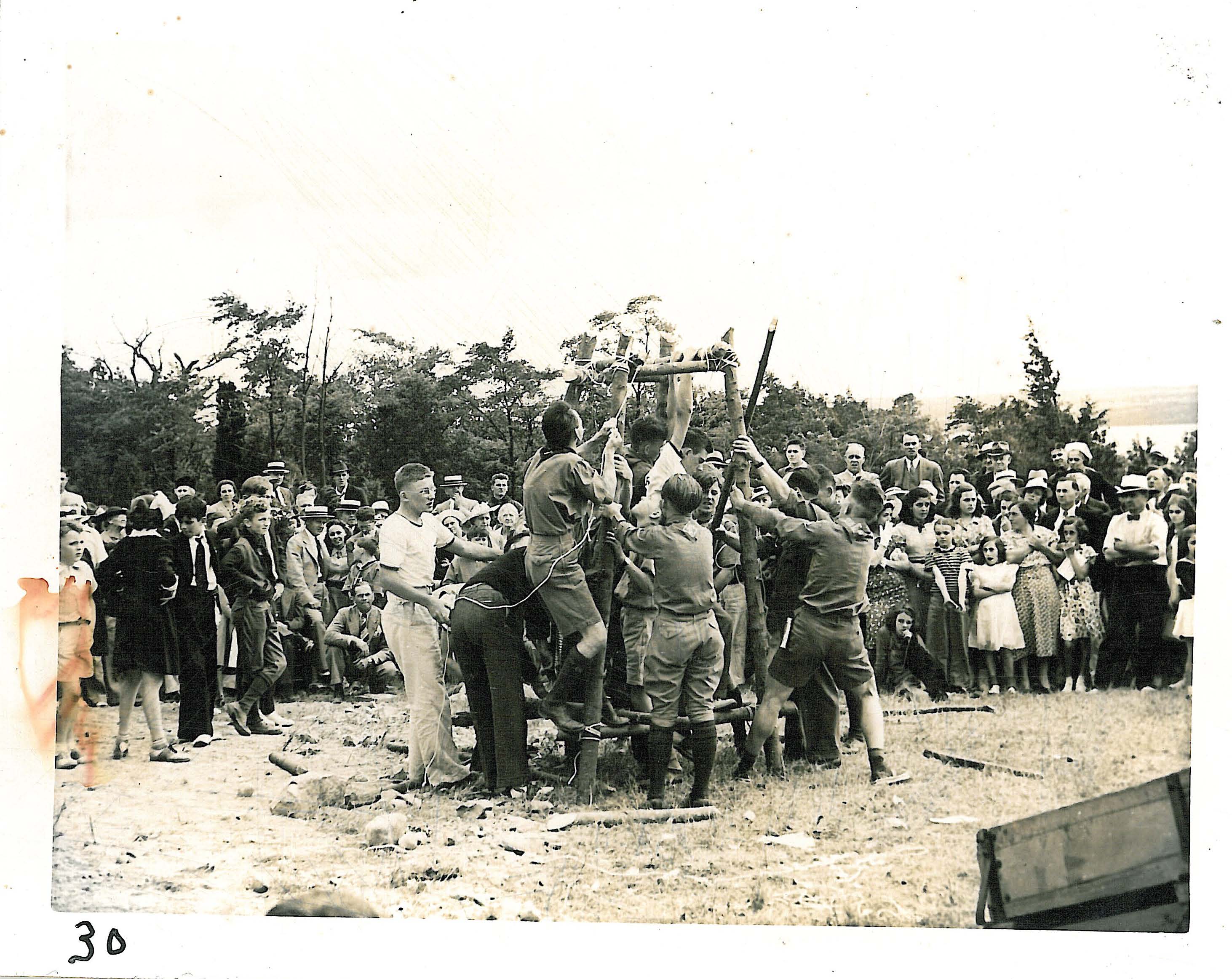
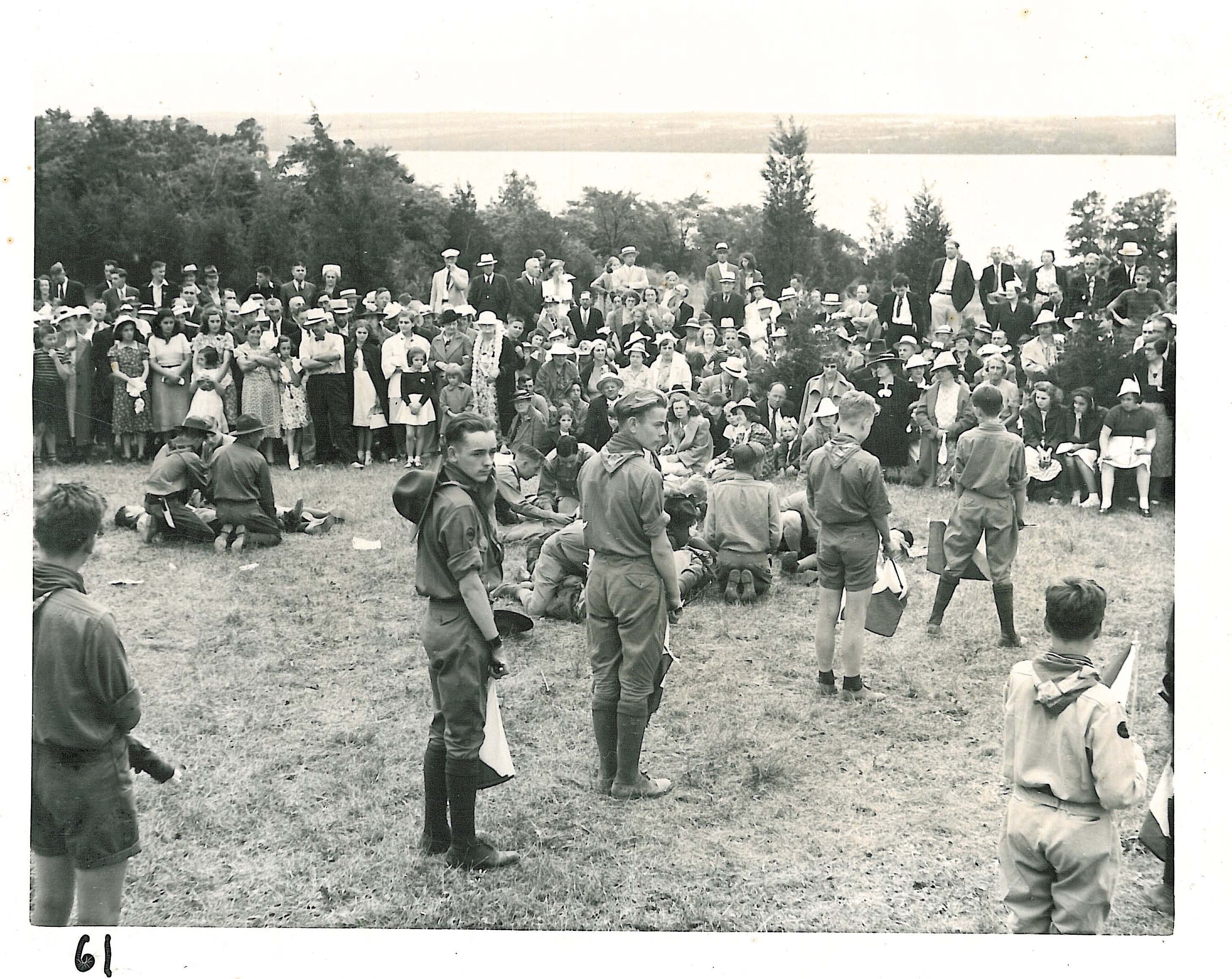
Scouts had the’r part in the program in a special presentation, “Scouting on parade,” for which the various commissioners, scoutmasters and troops had been preparing for weeks . The entertainment was under the personal direction of commissioner Arthur J. Cowan and included a rapid-fire demonstration of Scout skill and training which was a revelation to many of the visitors. The demonstration, carried on by picked patrols, included tower building, signaling, fire building, life saving, first aid ,etc. Each of the five Council district participated, each having one part of the demonstration.

Commissioners Praised
Fred D. Quinn, Council executive, had words of praise for the commissioners, Scouters and the camp dedication committee. He mentioned toe gift of Norman Gould, Seneca Falls, of a complete water system for the camp and cafeteria equipment for the kitchen. Mr. Quinn told of the months of hard work on the part of the camp committees, labor in the winter snow on the camp site, nights of study and conferences and weeks of volunteer tone. He described the physical aspects of the camp, explained its features and invited the guests to inspect the buildings, tents and area. More than 70 Scouts came in early in the afternoon for the second of the camp periods. Following Mr. Quinn’s talk, toe benediction was given by the Rev. Richard F. Wentz. Seneca Falls.
Dedication Committee
Members of the camp dedication committee were: Justice Nathan D. Lapham, chairman George Lawson, Dundee, vice-chairman; Barry Weart, Seneca Falls, vice-chairman; William Chilson. Geneva, treasurer; Charles c. Lobert, Geneva, finance; Fred D. Quinn, arrangements; X. C. Lautenslager, Geneva, publicity; Justice Lapham, invitations; Lee H. Leland, Clifton Springs, attendance; Prof. L. R. Loomis, Keuka Park, public relations; C. A. Mitchell, Geneva, transportation; H. T. Yells. Waterloo, public welfare; A. J. Cowan, Geneva, program activities; Niels Iverson, Gorham, stage; James P. Donovan, Canandaigua, properties; Charles S. Wilson, Hall, camp naming.
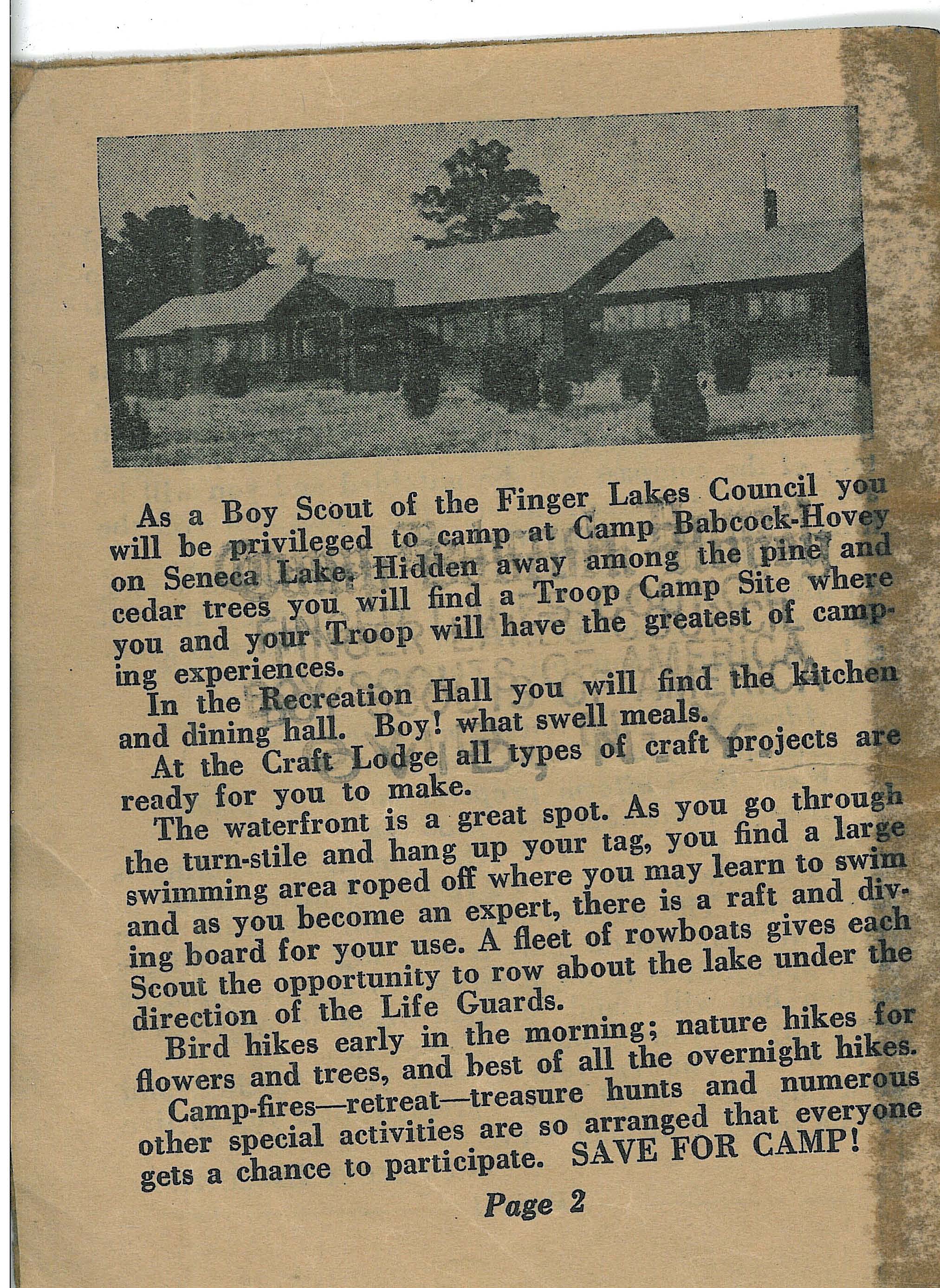
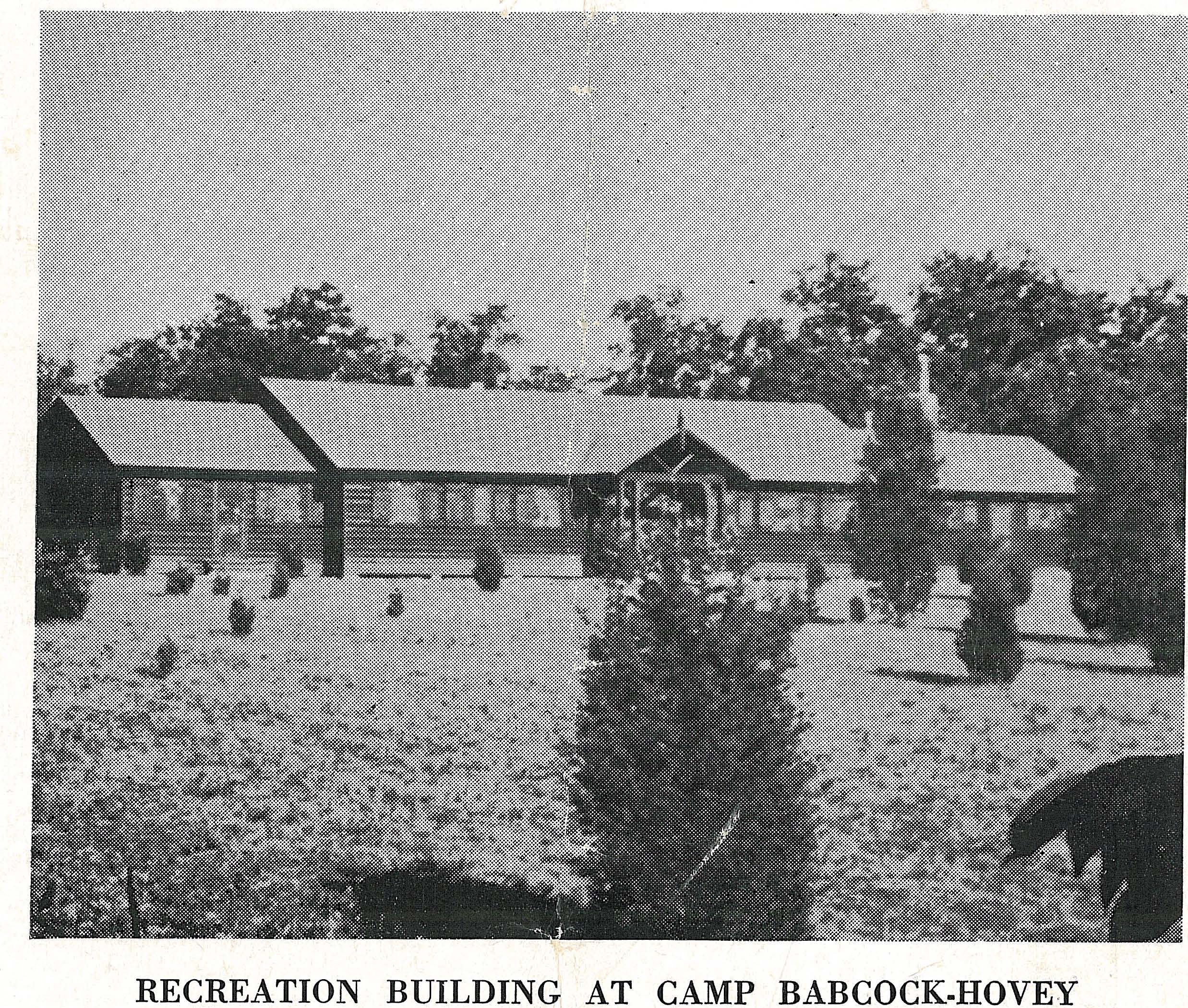
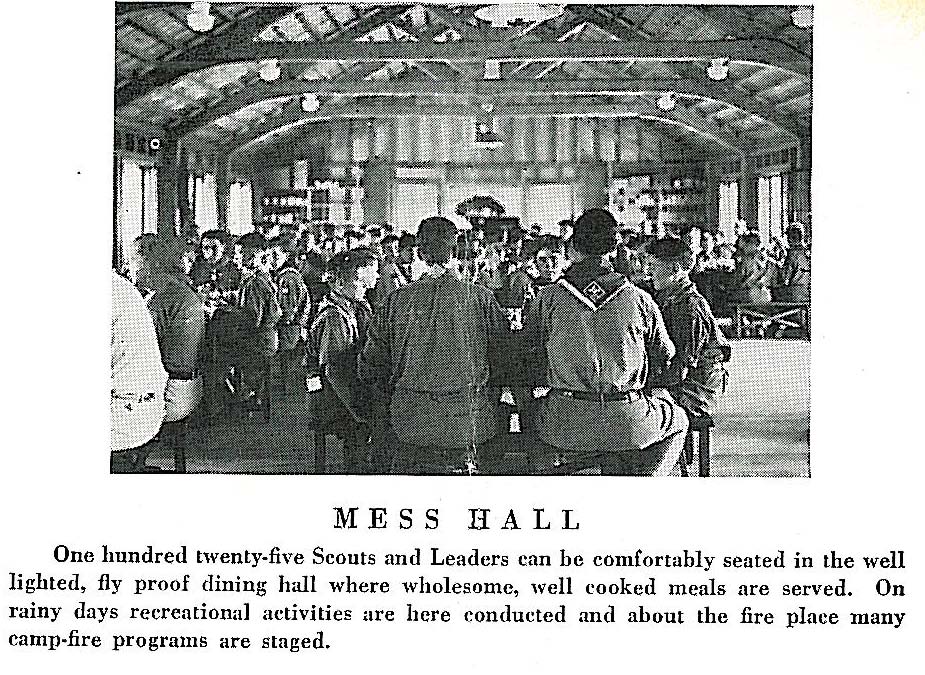
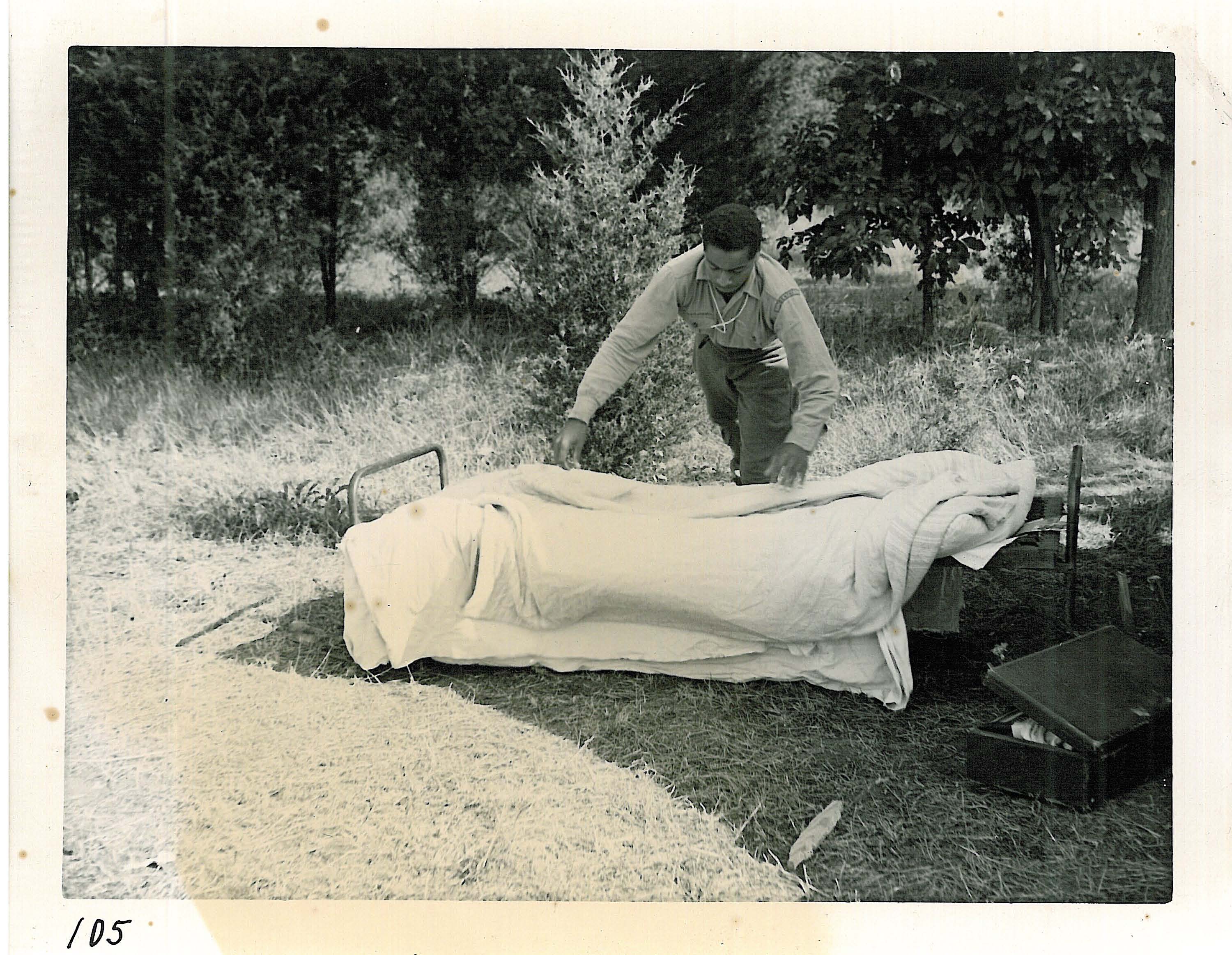
Much development work has been carried on by the Scouts since the opening of the camp on July 9. The boys are building nature study trails and have built a fence around the low bluff on the lake front. Other work has been planned. As is the custom in many Scout camps, the area has been divided into several “villages,” each equipped with large tents on wooden platforms, a frame toilet and washroom and water. The large lodge accommodates more than 125 boys at tables. There is a completely equipped kitchen, with living quarters for the cook and in the lodge is an office, first aid room, library and storeroom.
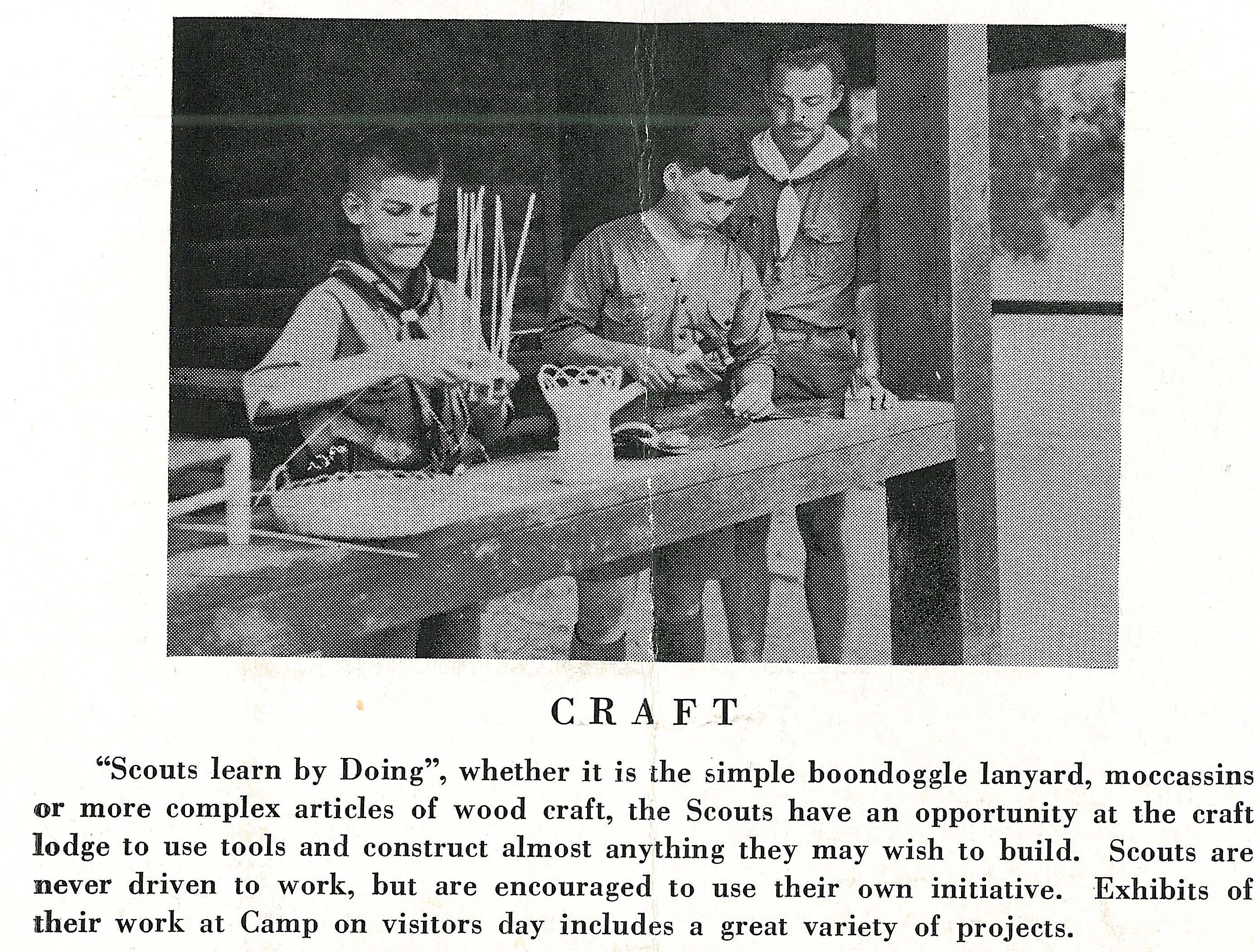
Another point of interest is the handicraft lodge where space under shelter is provided by groups of boys working on handicraft projects. According to the parents of the boys in camp, the new camp has met with enthusiastic approval from the first groups.
Luncheon Guests
Among the guests at the luncheon given by Judge Lapham at the Geneva Country Club were the following: Birton E. Babcock, Phelps; Mr. and Mrs. Harry E. Hovey, Geneva; Hon. and Mrs. Norman J. Gould, Seneca Falls; Dr. and Mrs. Frank L. Christian Elmira; Warden and Mrs. Joseph H. Brophy, Auburn; Mr. and Mrs. Harold W. Sanford, Rochester; Dr. and Mrs. J. Hillls Miller. Keuka Park; Dr.
and Mrs. Murray Bartlett, Geneva; Amory Houghton, corning; Mr. and Mrs. H. M. Eisenhart, Rochester; Hon. and Mrs. John Taber, Auburn; Dr. and Mrs. Alfred W.
Armstrong, Canandaigua; David E. Gray, Corning; Mrs. Robert F. Thompson, Canandaigua; O. H. Benson, National Director Rural Scouting. New York; W. H. Curtiss, Corning; Mr. and Mrs. Clarence Andrews, Penn Tan; Mr. and Mrs.
Charles Andrews, Perm Yan; Prof, and Mrs. L. R. Loomis, KeukaPark; Hon. and Mrs. Earle S. Warner, Phelps; Hon. and Mrs. Harry Marble, Holcomb; Dr. P. J. Parrott, Geneva; Hon. and Mrs. Fred D. Cribb, Canandaigua; Rev. Raymond Nolan, Geneva.; Rev, Richard F. Wentz, Seneca Falls; Merton Smith, Perm Yan; Mr. and Mrs. W.A. Gracey Geneva; Mr. and Mrs. Frank Widmer, Hon. Lee H. Leland, Springs.
(As Reported in the Geneva Daily Times Monday July 17,1939)






-
- Dedication at Camp Babcock-Hovey the Best Boy Scout Camp in the Finger Lakes Region of New York




#8 Birton Babcock and Harry Hovey
There is a striking similarity of the careers of these two men, H. E. Hovey and B. E. Babcock, who have made Camp Babcock-Hovey possible. Both were farm boys and both started in business with little or no financial backing. Each went on to be the head of a successful business enterprise employing a large number of persons, and each had retained a deep interest and sympathy in the struggles of others and the welfare of his respective community.

Birton E. Babcock
Birton E. Babcock was born on May 20, 1870, in Clyde, Ohio. Mr. Babcock left home as a young man with $25 in his pocket to attend Wooster College in Wooster, Ohio, graduating in 1894 and attended Lane Theological Seminary in 1898. Mr. Babcock moved to the Finger Lakes area in 1901, with his wife, the former Edna Charlotte wilder, and purchased a sauerkraut factory for $4,000 ($1,000 down). From his humble beginning, Mr. Babcock built a sauerkraut empire known as Empire State Pickling Company, a million dollar business that produced one third of the nation’s kraut and was known as the “Kraut King”. Phelps still celebrates a Sauerkraut festival every year.
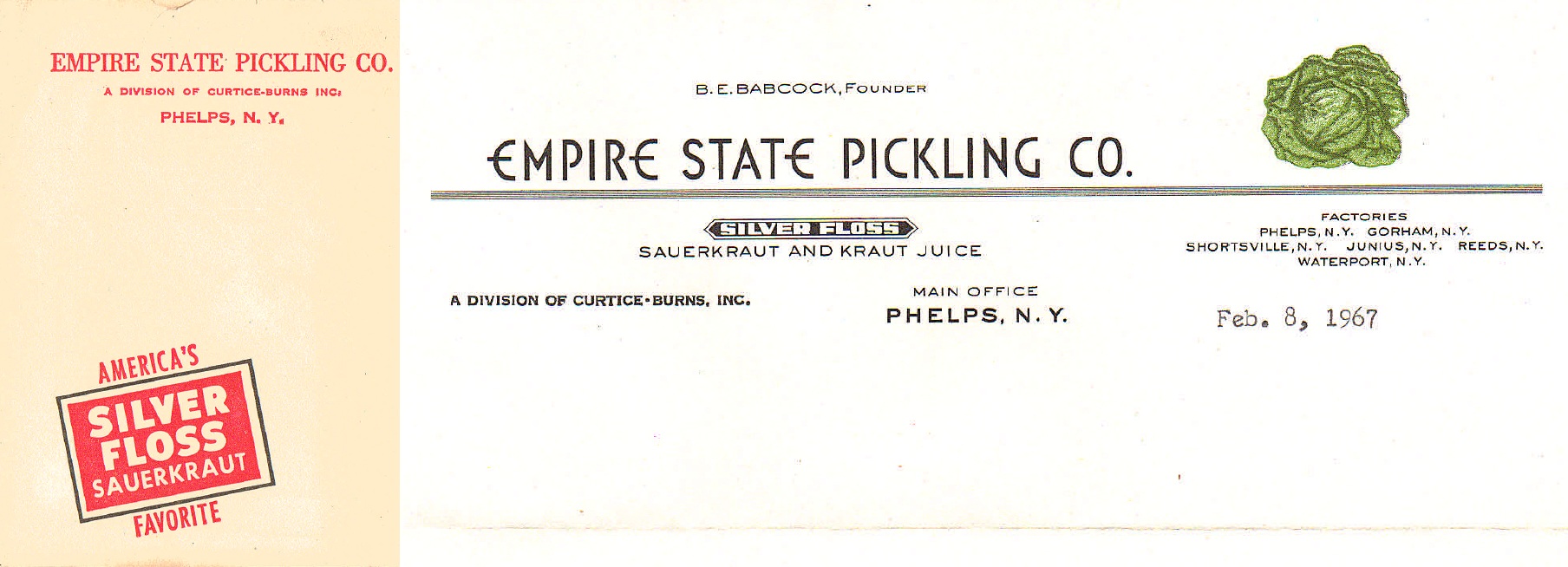
Mr. Babcock was a well-known civic leader, in the Ontario area, who believed in giving back to the community some of the blessings bestowed upon him. Besides our Boy Scout Camp, Mr. Babcock donated a women’s dormitory to Wooster College in 1936 that was named Babcock Hall, was a regular generous donor to the Phelps Presbyterian Church, the Geneva Girl Scout council, the Community Chest and Clifton Springs Hospital (Sanitarium). Mr. Babcock also served as chairman of the board at Clifton Springs Sanitarium. Mr. babcock was an elder of his church as well as a trustee at Wooster College. Mr. Babcock once stated that after a careful and thoughtful survey, he believes that the Scout movement offers to American youth the most vital training in the principles of democracy and religious tolerance.
Mr. Babcock had four children, all of whom passed away at an early age. His wife died about a month after the camp dedication. Mr. Babcock died April 7, 1941, at his office, of heart failure. The Camp Chapel was dedicated in his honor during the Wooden Anniversary of Camp.
(As Posted in the Camp Babcock Hovey Golden Jubilee Commemorative Book with edits)
Harry E. Hovey
Harry E. Hovey, of Geneva, was born on Warsaw, New York on January 4,1881, the son of Wilbur H. and Eva Arnold Hovey. He attended school in Warsaw and at age 17 he enlisted in the army He served in the Spanish-American War in the Philippines.
Mr. Hovey opened his first grocery store in Warsaw in 1901, investing $450 after his return from the service. His first store in Geneva was opened in 1915. From this beginning, the Market basket chain of grocery and other stores grew to well over 260 retail outlets. Mr. Hovey married the former Carrie Smith of Cortland in 1907, and had six children, three sons and three daughters, many of whom were involved in their fathers business.

Mr. Hovey was very involved in civic affairs. Mr. Hovey was a board member of the Salvation Army, and officer of Rotary International, upstate chairmen of the USO, and a trustee of Hobart and William Smith colleges. Mr. Hovey was also a regular contributor to the Community Chest and a member of the North Presbyterian Church of Geneva. In Scouting, Mr. Hovey was the co-founder of our camp. Prior to the founding of camp, Mr. Hovey had long been interested in Scouting, and Troop 12, of Geneva, was sponsored by the Market Basket Corporation, while Troop 9 and Rotary Sea Scout Ship meet in the Market Basket trophy room. Mr. Hovey also received the Silver Beaver Award for his service to youth. The former Hovey Lodge was donated by Mr. Hovey in 1948 and was dedicated in his honor. Mr. Hovey died on November 2, 1953 at his Main Street home in Geneva.
(Memory of Hovey from 50th Anniversary coming soon)
(As Posted in the Camp Babcock Hovey Golden Jubilee Commemorative Book with edits)
#7 The Camp Property before there was a Camp
The land was part of Military Tract #7 and in Ovid Military Township No. 16 These military lots were laid out and granted to officers and soldiers of the Revolutionary War as gratuity payment for military service. According to the record of Lot No. 7 in the Seneca County Clerk‘s Office it was granted to Jacob Van Gelder, a soldier in the New York Line. He may have been killed in the war or died soon afterward for he never occupied the land. For reference, see a deed by Reuben Van Gelder, Administrator and heir to the estate of Jacob Van Gelder to one Stephen Thorn date Sept. 13, 1791, filed in the County Clerk‘s Office in Liber F page 504, given to Jacob VanGelder, a Revolutionary War Soldier. The Property was not occupied before this time as, John Seeley was the first pioneer of Ovid Village, not coming until 1792.

The Property did not remain in the name of Stephen Thorn very long, because a very early owner was Jacob Smith and then it remained in the Smith family until 1859. Jacob Smith was the original Smith owner. Rachel Smith was his wife. In 1811, Peter Smith and Jeremiah deeded 19 acres to Jacob Smith. In 1828, the title was transferred to Peter Smith. In 1832, the Sheriff took part of the farm from John W. Smith for owing $300. On December 18, 1859, Alexander Smith (grandson of Peter Smith) sold the property (147 ¾ acres) to Stephen V.R. Johnson and Lawrence Van Dusen. The Smith Family Cemetery is located on the property off of the Raccoon trail (2012). The remains of the last Smith to occupy the lands can be found there. John W. Smiths tombstone read that he died Feb 27, 1859 before it was removed in 1998. Other tombstones were unreadable as of 1998.

Stephen V.R. Johnson was the owner for many years until at least 1890 as he sold a parcel to the Lehigh Valley Railroad for the construction of the railroad. At some point after this the property was foreclosed upon for taxes.

The property was deeded to the Boy Scouts by two deeds as follows:
1. The bulk of the property was deeded by The First National Bank of Ovid to Finger Lakes Council, Boy Scouts of America, Inc. on February 24, 1939, recorded in Liber 173 at page 475. The cost was reported as $3,000. This parcel was comprised 177 ¾ acres of land.
2. Leonard S. Cole, Fannie L. Cole, his wife and Robert J. Cole and Myra J. Cole his wife to Finger Lakes Council, Boy Scouts of America, Inc. on June 10, 1939, recorded in Liber 173 at page 559 for the very reasonably fee of $1. This parcel was .241 acres of land at the entrance on the Willard-Lodi highway.
Historic Deed transfers from the county clerks office
At the time of the sale there was a cottage located in the ravine between Tuscarora Campsite (2012) and Sunday Night Campfire Area (2012). The stone walls can still be made out as you cross the bridge if you look to your east.

The Johnson family farm house was located just east of the small nature pond as you enter camp, in what is now know as the refrigerator graveyard (2012) but will hopefully soon become the rangers shop complex. As of 2012, one can still make out the basement foundation. At the entrance to the Raccoon trail (2012) near the pond if you look east you can still make out the old road. Here is an aerial photograph from 1936. Take a look back at yesterday’s post for the camp road contracts/map and you can see how it now deviates.

In 1944, there was a boundary line agreement to establish the southerly boundary of the camp property. The agreement was between the Finger Lakes Council, Boy Scouts of America, Inc.; Hanns D. Kniepkamp, the owner to the couth; and the State of New York as a purchaser of the property to the south. This agreement was dated April 7, 1944 and is recorded in Liber 188 at page 540.

The southern portion of the Camp was declared surplus farmland and bought in in 1962. More details on this transaction will be reported on at a latter date.
#6 The Transition from Camp Tarion
The following has been assembled from newspaper clippings and my memories of what skip told me. Click on the link and it will take you to the newspaper that is summarized below the link.
1936.07.22 – Alls ok at camp tarion
1) It is reported that as of July 1936 Camp Tarion had a successful season
1937.02.06 – Camp tarion financial problems
2) However as of February 1937 Camp Tarion’s financial and operating problems come to light. “Many alterations and improvements are necessary to the camp property and equipment at Camp Tarion, on Canandaigua Lake, to insure the health and safety of Scouts attending. The knotty problem of finance was dealt with at some length by the Scout Executive and he pointed out that more money is necessary immediately to “guarantee any expansion in the program of Scouting in the Finger Lakes Council.””
1937.03.26 – List of items need for camp, no funds requested yet
3) In March of 1937 a report on camping for 1937 was made by Harry Weart, of Seneca Falls. Needs for the coming season were discussed but no dates for the operating of Camp Tarion, Scout camp on Canandaigua lake were set.
1937.05.07 – Camp Tarion closed – Penn yan democrat
4) In April of 1937 it was announced that “Camp Tarion, Finger Lakes Council Boy Scout camp on Canandaigua Lake, will not be operated this summer. The decision was reached at a meeting of the executive board of the Council held in conjunction with the annual training conclave at the Y.M.C.A. here last night. Scout Executive Frederick D. Quinn said this morning that council finances make operation of the camp impossible this year. Scouts of the three-county area of the Council who desire to go to camp this year will be taken care of through arrangements now being made with neighboring Councils operating camps.”
5) Rochester’s Council Camp Pioneer was one of those camps. Additionally other troops conducted experimental camping at various other locations during the 1937 season. One of those locations was the Johnson farm on Seneca Lake near Gilbert Station. 1937 was the first year that troops camped at what would be know as Camp Babcock-Hovey. Therefore 1937 is used as the birth of Camp Babcock-Hovey even through it would take another two years to open the camp.
1937.11.17 – FLC possibly looking for a new camp – The Naples record
1937.11.17 – FLC possibly looking for a new camp – The Naples News
6) In November of 1937 it was announced the sale of Camp Tarion is Being Considered. “It is considered somewhat inaccessible for the use of a large group and the level area is too small to give space for athletic sports which is desirable to incorporate in the camp program. A large site is desired“. A committee is formed to “investigate offers for the present campsite and possible new sites.
1938.01.26 – Defiently selling camp tarion
7) As of January 1938 “camp problems of Finger Lakes Council. Boy Scouts, are being studied by both members of the executive board and the camp committee. The Council has definitely abandoned Camp Tarion on Canandaigua Lake, now offered for sale. No definite plans have been made for a substitute and committee members are seeking the views of scoutmasters on the type of a camp program moat desired, leaders report.”
8) One of those locations being considered was the Johnson Farm on Seneca Lake near Gilbert Station.
1938.04.13 – Seven month lease with option to buy at end property near Gilbert Station
1938.04.20 – Seven month lease reported in naples news
9) In April of 1937, “Finger Lakes Council , Boy Scouts of America, has taken a seven months’ lease with option to buy on a 147 acre tract of the S.V.D. Johnson farm at Gilbert Station on the east shore of Seneca Lake, south of Willard, for experimental camping purposes” …“Described as a wonderful camp site and “ideal for Scout camping purposes.” the tract of land leased has 1,500 feet lake frontage, is well located. It adjoins the Willard State Hospital farm. The camp committee was given authority by the executive committee to draft plans for temporary troop camps under canvas. No Authority was given for any expenditure and the plans of the camp committee will have to be such as come within financial ability of the council to meet, it was said.” Chairman Harry Weart of the Camp Committee told the executive board that during the past one and a half years since closing of Camp Tarion, the camp committee has been carefully studying the camp problem and has inspected 14 different properties in three counties of Ontario, Seneca and Yates. The Camp committee will meet to make plans for use of the new site this week in Geneva. The big problem, it is said, is to bring the plans within the means of the Council.”
1938.05.03 – No funds for new camp of boy scouts
10) As of May 1938, the hopes of officials of the Finger Lakes Council, Boy Scouts of America, to make use of the new experimental camp grounds on the east shore of Seneca Lake near Gilbert station, were dashed last night when it was found that lack of funds would make it necessary to follow the same camp procedure as last year.”
11) In addition to camping at Camp Pioneer again, some troops camped at the Johnson farm once again in order to prepare the camp for use the following year. Sometime during 1937 Supreme Court Justice Nathan D. Lapham, was appointed as chairman of the committee on special contributions.
1938.11.16 – Large gift to purchase property but donor name kept secret – DC – but doner is present
1938.11.16 – Large gift to purchase property but donor name kept secret
12) However it wasn’t until November 16, 1938 that “An anonymous gift of a large sum of money to Finger Lakes Council, Boy Scouts of America, will make possible the immediate purchase and development of a summer camp on Seneca. Announcement of the gift was made at a special meeting of the Board of Directors last night in the Genera Country Club. The directors and other Council officers were guests of Supreme Court Justice Nathan D. Lapham, chairman of a special committee which has been seeking funds for the camp project. The Council includes troops in Ontario, Yates and Seneca counties. At the dinner were President George Lawson. Dundee; Council Executive Fred D. Quinn; William Chileon, Geneva, treasurer, Harry Weart, chairman of the camp committee and the following directors: Henry Parmale, Hotcomb; B. E. Babcock, Phelps; Dr. Murray Bartlett, Geneva; Charles S. Wilson, Ball; Prank Widmer. Naples; Dr. A- W. Armstrong, Canandaigua; Neils Iverson, Gorham; George C Sweet, Waterloo; H. Merton Smith, Penn Tan; Ira M Croucher, Canandaigua; Justice Lapham, and Fred Story, Seneca Falls.
Justice Lapham said that the donor had requested that his name be withheld in connection with the gift but he indicated that he hoped later to’ persuade him to permit the name to be used so that the hundreds of Scouts in the three-county area would know to whom they are indebted. The name was not mentioned at the meeting. It was learned, however, that the unidentified donor was among those present.
An option on the purchase of a 147-acre site on the east shore of
Seneca Lake, south of Willard, expired last night but the directors were able to exercise the option for the purchase of the land. The price was set at $8,000. Quinn said that funds are available to start development work immediately.”… “Committees of the Council for months have made a study of available sites and an engineer from National Headquarters made a special survey of the new site, pronouncing it ideal. There is an excellent beach, the tract is heavily wooded, with many attractive glens and spaces for troop camps, athletic fields and the like. Good water is available. The site is easily reached, on good highways. According to present plans several buildings will be constructed and tents’ will be used to shelter the boys. Maps have been drawn and the tentative layout approved by leaders in the area. The plans call for accommodation next summer for 79 boys per week, plus leadership.
1938.11.30 – Camp Tarion sold – Naples News
1938.11.30 – Camp Tarion sold – Naples Record
13) Coincidentally Camp Tarion was sold November 11, 1930. “The equipment now stored at the camp will be used at the new Scout camp on Seneca Lake”
1938.12.06 – Work begins on Camp Near Gilbert Station
14) December 1938, Work will be started within 30 days on development of the new camp site of the Finger Lakes Council, Boy Scouts of America, on the east shore of Seneca Lake near Gilbert Station following action of the executive board and committees at the last session of the calendar year here last night. The business meeting was preceded by a dinner at the First Presbyterian church. Camping equipment from Camp Tarion, former camp on Canandaigua Lake, retained when the property was sold to a Washington, D. C. man, will be moved from storage at Naples and checked over. Drilling for water on the new site will also be started and location of a good drinking water supply will largely determine the site of the proposed dining hall. The Council, the board decided last night, will develop its new camp to make it most suitable for Scouts of 12 and 13 years of age, constituting a majority of Scouts in the territory. Wishes of parents and the donors of the large gifts for the camp will also be taken into consideration. Harry Weart, Seneca Falls, chairman of the camp committee, reported briefly on activities during the past month.”
1939.01.05 – Camp Donation announcement
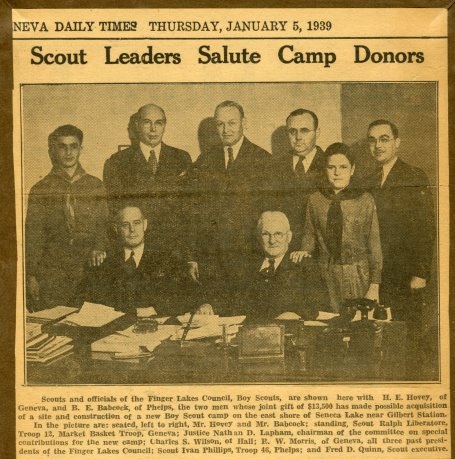
15) In January of 1939, It is finally announced who the anonymous benefactor were. “A joint gift of $13,500 by H. E. Hovey, of Geneva, and Birton E. Babcock, of Phelps, will make possible the new camp of the Finger Lakes council, Boy Scouts on the east shore of Seneca Lake near Gilbert Station, it was announced at a special meeting of the executive board in the offices of the Chamber of Commerce here last night.
Officials of the Council made the announcement public this morning with great rejoicing pointing out that the generosity of Mr. Hovey and Mr. Babcock has given Scouting in the tri-county Council area of Ontario, Seneca and Yates Counties one of its biggest boosts. Announcement of the joint gift was made by Supreme Court Justice N. D. Lapham, chairman of the committee on special contributions. “This is the most outstanding announcement ever made in the history of the Finger Lakes Council, Boy scouts,” justice Lapham declared, In revealing the donors of the new camp. “The new camp will be the greatest benefit to the Scouts in the council’s three-county area and provide one of the biggest incentives to Scouting In its program of character-building for boys in this region.”
The executive board last night named a special camp development and construction committee, headed by Harry Weart, of Seneca Falls, as chairman. Other members are: Charles s. Wilson, Hall; B. W. Morris, Stark, Penn Yan, Donovan, Canandaigua. Work will be started at once to have the new camp ready for the 1939 season. Tentative plans call for a camp to accommodate over 100 boys per week under canvas. There will be a central kitchen and dining facility. Troops will camp in units of 32 each, information for contractors on well drilling is now in the mails. Plans are also under consideration for bringing electricity to the site.
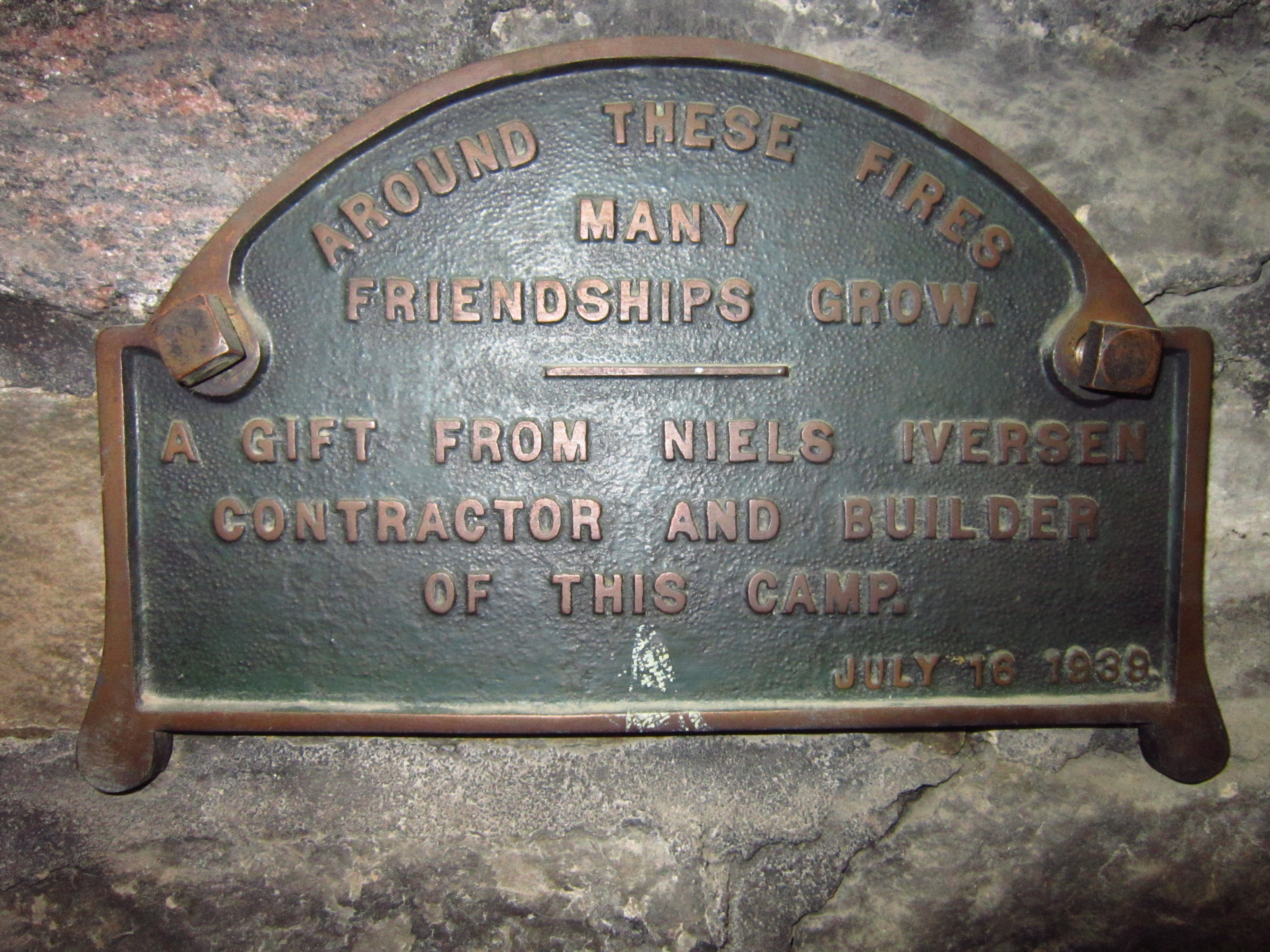
16) One of the first developments of Camp Babcock-Hovey was the main camp road. This was awarded to Howard W. Keeney on April 28, 1939. The road was eight feet wide and had several “turn outs” where two vehicles could pass. The cost was $500. This gave the dining hall contractor, Neils Iverson, access to begin work. The dining hall was completed by the Camp Babcock Hovey dedication at a cost of $5865.40. In includes a beautiful stone fireplace, which was a gift of Mr. Iverson. It states “Around these fire many friendships grow”.
The water system, a 200 foot well was also in place, it still exist as of 2012 near the current kitchen propane tanks. A camp maintenance facility concluded the camp development of the 1930’s.

Interesting Fact
Scout Power had a lot to do with the election of Justice Nathan D. Lapham to fill the seat of former justice Robert F. Thompson. It has been said that because of Justice Nathan D. Lapham support for Scouting he was easily able to defeat the interim incumbent to fill the seat held by Justice Robert F. Thompson.
A little about Robert F. Thompson. There were many men in the forefront of the Scouting movement in the Finger Lakes area. The preeminent moving force behind the early development of the Council, however, was Judge Robert Thomson of Phelps. Judge Thomson, who’s wife was a founder of Girl Scouting, held many Courts of Honor in his own court in Canandaigua, organized jamborees, encouraged leaders and for decades did all manner of good turns for young people. An oak tree outside his former chambers was planted in his honor. When Judge Thomson died in 1937 he requested that all his pall bearers be Eagle Scouts. Troop 39 of Manchester planted the oak tree and placed a plaque on the Court House Lawn in Canandaigua.
Did you see that?
Did you see that? Did you catch that picture of Judge Lapham and James E West the first Chief Scout Executive? Take a closer look at the Judge Lapham post and check it out for yourself, here is a picture of James E. West to help you along.

Ever wonder if the theory of six degrees of separation is true? It might be. Think of this. James E. West knew Judge Lapham -> Judge Lapham shook hands with Skip -> And Skip shook hands with most of you. That’s only three degrees of separation. Four at most if you never shook hands with Skip. Interesting!
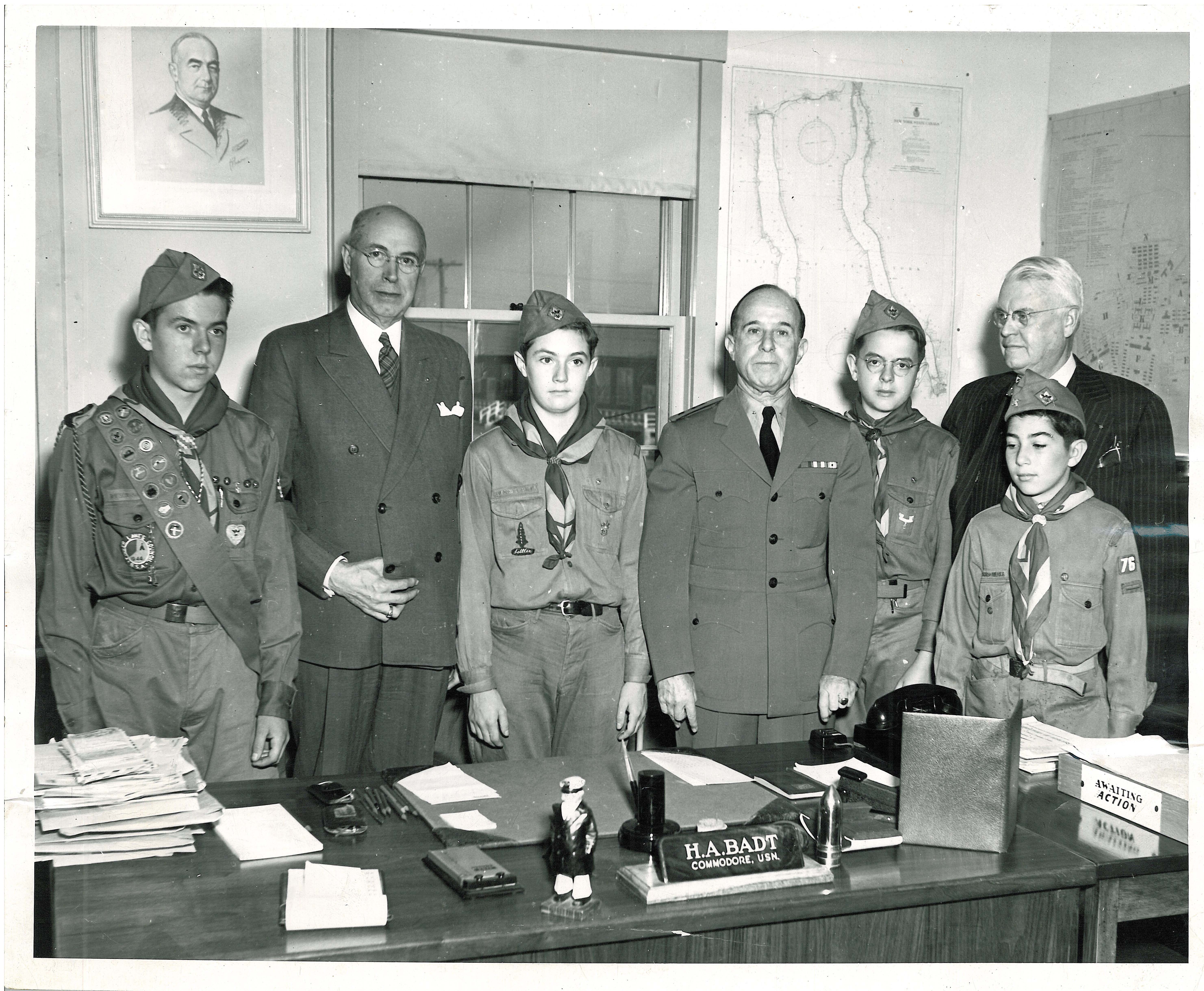
#5 The Honorable Nathan D. Lapham

Nathan D. Lapham was born in Macedon, Wayne County, NY on November 14, 1871. His father was a prosperous farmer and local politician. He graduated from Macedon Academy and Cornell Law School, and was admitted to the bar on December 26, 1895. For two years he practiced law in Lyons, NY with Clyde Knapp, following which he practiced alone for seven years. In 1904 he moved to Geneva, NY where he practiced trail law in partnership until 1937.
Lapham was active in the Republican Party in both Wayne and Ontario County. His first political office was a two year appointment as clerk of the Wayne County Board of Supervisors. In Ontario County, he held office as Geneva city Attorney from 1912 to 1916, being appointed District Attorney in the latter year. He was elected seven times to his post, holding office from 1916 to 1930 and again from 1932 to he close of 1937. In his last year, he was elected to the supreme Court from the Seventh District, defeating interim incumbent, James P. B. Duffy. He presided until his mandatory retirement at the close of 1941, also serving on the Governor’s Crime Commission. Following his departure from the bench, he function as an Official Referee for sixteen years, eventually resigning due to health troubles. He died in Geneva on May 5, 1958.
Justice Nathan D. Lapham served as Council president for many years. Justice Lapham also served the Council as a member of the National Council of the Boy Scouts of America in the capacity, of representative of the Finger Lakes Council. Justice Lapham also served as chairman of the committee on special contributions. which was instrumental in securing the necessary funds for the development of the new Scout Camp Babcock-Hovey
(Complied in Part by Rob Cunningham, a member the Seneca Waterways Historical Society )
OA Dock Fund
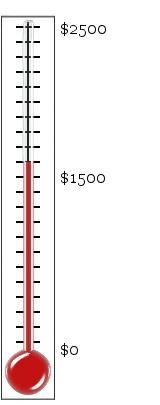 There is an attached flyer for the OA dock fund going in at Poolers Pond. It is hopeful this year that we will raise enough funds to cover the cost of a floatable dock, OA Shed, and wind aerator (If needed based on DO readings). If there is a surplus we will look at purchasing some picnic tables, building a one seater latrine, and possibly a small shelter similar to the archery shelter. Just a reminder that we are receiving a matching donation to this fund by an anonymous donor up to $2,500 but you must use this form in order for it to count towards that donation.
Form can be found here-
#4 Harry Weart
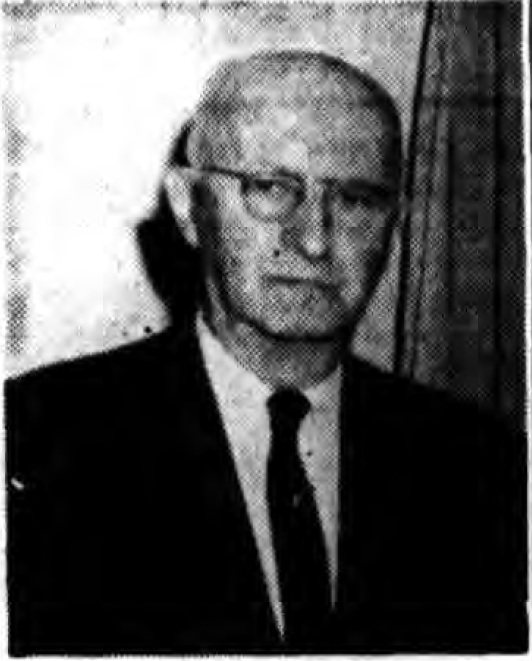
Harry Weart was born in Sandy Creek, NY in 1881. After Serving with the U.S. Army in France during World War I, he attended Syracuse University, graduating as a mechanical engineer in 1923. He was the superintendent of number 2 shop.
In 1922, he was married and had two sons. Harry Walton “Wally” Weart was very active in Scouting. He was an Eagle Scout in Troop 80 and became a professor in Missouri. David Weart is a real estate broker in Naples, NY.
He served as Mayor of Seneca Falls and on the town committee. He was also an elder of the Presbyterian church.
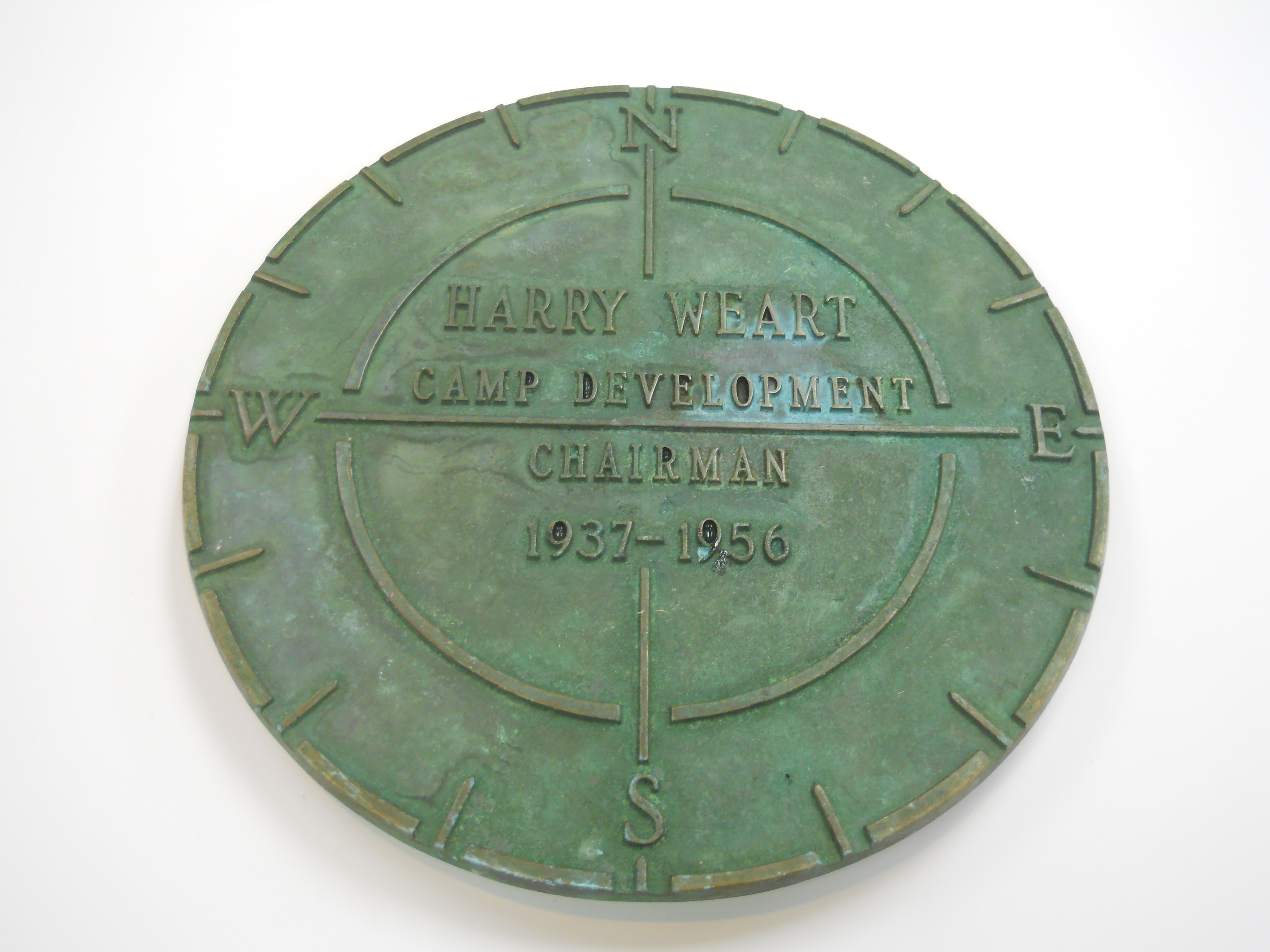
He Served as Camp Babcock-Hovey Development chairman from 1937 to 1952. He received the Silver Beaver Award and also served as District Commisioner. There is a monument on the parade field at camp in memory of Mr. Weart. He Died in the 1960’s.
(As Posted in the Camp Babcock Hovey Golden Jubilee Commemorative Book)
Editors Note- The monument crumbled during the 2000’s and the attached sundial was removed for safe keeping. There are plans in place to replace the Sundial soon.

 Babcock-Hovey Alumni Association